
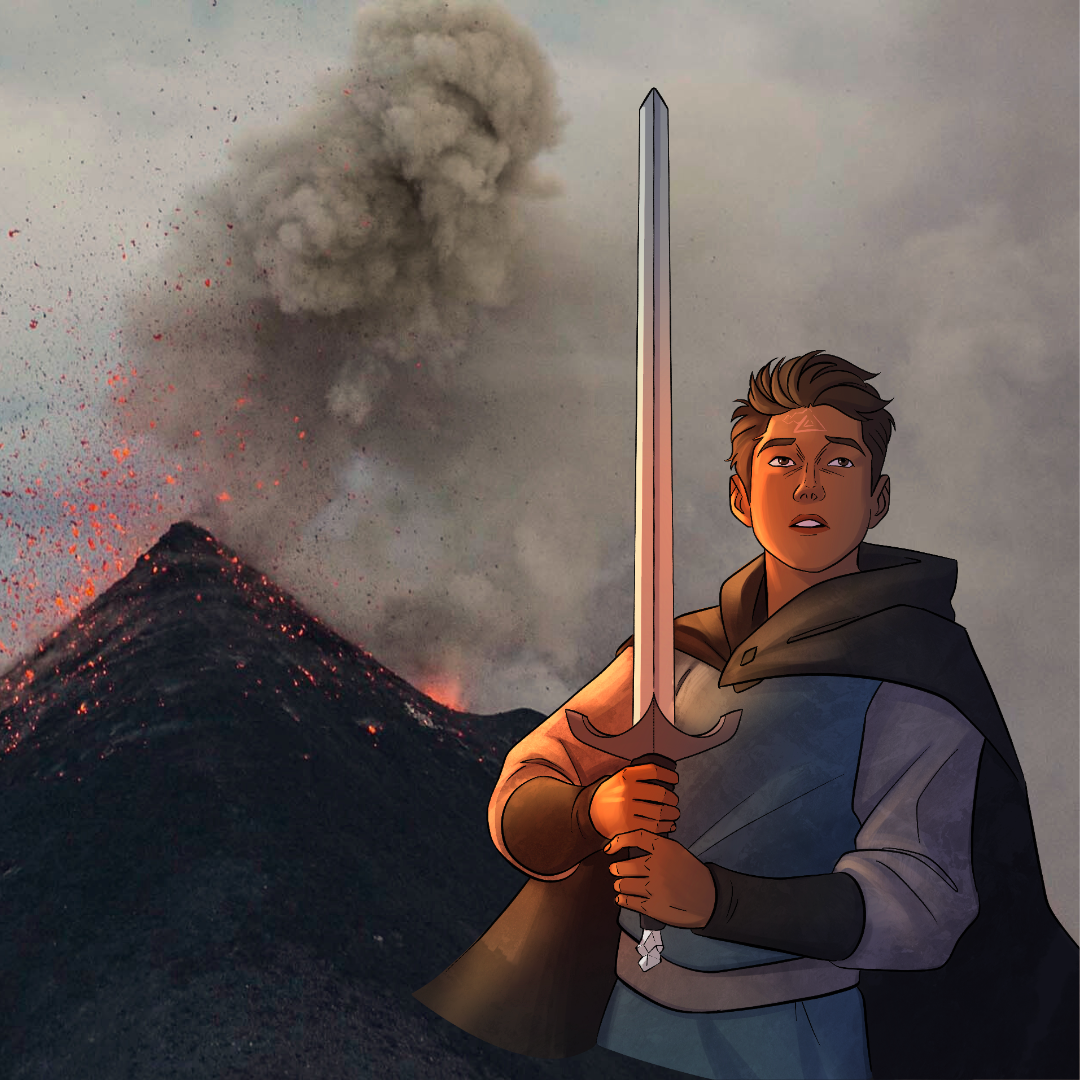

As the primary protagonist in this story, all eyes are on Doran. He has a big job to do— moving the plot forward with every choice, opposed by the antagonist at every step, forced to face his greatest fears and conquer his deepest weaknesses to come out alive and thriving. And he manages to do all this with a healthy dose of pessimistic sarcasm and defiant wit. When you ask who my favorite character is (although no one has yet… I suppose that makes you the first—thanks for asking!), I can easily say that it’s Doran, not only for the almost maternal bond a writer forms with her protagonist, but for his attitude about life. I just think he’s funny.
But there’s a lot more to Doran than one might think at first introduction, layers which the story uncovers, and many which are yet to be discovered. This post will look at four elements of his character: design, backstory, arc, and the “Jeremiah Factor.” Let’s dive in.
Design
Although a lot of things about Doran’s character changed throughout the early stages of writing, one thing was always clear in my mind: he had a limp. There were a couple of reasons this was important. First, I wanted him to have an external weakness that pointed to his inner cry for strength, something about his tangible life that made everything just a little harder and required him to work just a little more than ordinary people. Second, and most importantly, the limp was a handy literary device to reveal the fire lands’ intolerance for anything perceived as feebleness. Throughout the story, we see characters who dismiss his value because of his deformity. General Isambard thinks Doran’s parents shouldn’t even have kept a baby with a malformed leg, and the townspeople in Flamebridge consider Doran bad luck.
More than considering how the limp affected others, however, I had to decide what Doran thought of his limp. Was he bitter about it? Was he sensitive and defensive of how other people saw him? Or maybe even strangely proud of it, like some kind of angsty protest against his society? I bypassed these melodramatic and, frankly, overdone reactions and instead settled on a healthy level of acceptance with a heaping handful of realistic affects on his daily life, as I suspect more accurately reflects the way most people with physical differences view themselves. Besides, Doran isn’t one to sit around feeling sorry for himself or wax eloquent about why you should. As for that realism thing, I took a walk with one shoe and one bare foot to get an idea of how it might feel to walk unevenly, and can confirm Doran’s complaints of back pain. I suspect he’ll have some arthritis in that back when he gets older…
Throughout the story, Doran finds that his unusual stance results in a much better grasp of balance and movement in sword fighting than most beginners, and he learns to compensate for the extra weight of a sword with his uneven legs. Despite how well adapted he is to his condition, you might have been surprised, upon reaching the end of the story, to find that the Giver didn’t heal Doran’s leg when he removed Isambard’s mark. This was an intentional choice, again prompted by scripture. As a big part of Doran’s journey is learning to depend on the Giver’s promises for strength, I thought it was important that he keep this constant reminder of his own weakness and his need to trust the Giver’s power instead of relying on his own. It’s a principle Paul expresses in 2 Corinthians 12:7-10.
This is a perfect time to make a segue into the second the most notable Doran’s characteristics: the brand. The brand was a slightly later addition that I made to drive home Isambard’s ownership and power over Doran. More importantly, it’s a symbol of the ownership Satan claims over us as sinners, and, when the Giver removes that brand, it serves as a poignant reminder that Jesus has redeemed us, claiming us as his own and marking us with His Spirit.
I also used the mark to illustrate various parts of Doran’s journey. After escaping the mine collapse, Doran tears a piece of his shirt to wear as a headband to cover the brand. At this point, he’s still terrified of Isambard and desperate to hide his history of slavery. Near the climax, before Doran’s confrontation with Isambard, he abandons the headband, no longer held back by his past or by his fear of the general; he’s ready to face them both, head on and holding nothing back. Granted, his confidence was misplaced and led to a disastrous downfall, but that’s how life is when you’re the protagonist of an adventure novel. *shrugs and sips tea*
Backstory
This might be the area that underwent the most changes during Doran’s development. I knew his parents were killed when he was a child and that Isambard had something to do with it, but when Doran first fumes about Isambard’s treatment of that backstory, lightly calling it a “debt to be paid off,” I really didn’t have much of an idea what it was all about. As the story progressed, the idea took clearer form in my mind, until Doran was able to tell the entire story to Mavis on the rooftop in Myway in one of my favorite scenes of the book. But it underwent yet another change when a plot twist at the end revealed Doran’s parents to be tiding bearers, killed in the genocide a decade ago. That’s right folks, as surprised as you were, I didn’t know it was coming either.
The backstory was important, not just because it gives Doran a sympathetic edge over soft-hearted readers (not my main intention, but a perky side effect nonetheless), but because it was what would prompt many of his choices throughout the story, including the inciting event, when Doran rescues Dara from the mob. Growing up in the dog-eat-dog world of Flamebridge, Doran would never have gotten involved in someone else’s fight, regardless of how defenseless the victim, but because of the connection he felt to Dara through his beloved granny, he threw everything aside to help. As he says at the end of the first chapter, “This time, I could save her,” cluing the readers in early on to the deep pain his history holds and how desperately he wants a chance to redeem himself.
That desire to redeem himself comes up multiple times throughout the story in the form of agonizing guilt and a crippling insecurity about his ability to protect the people he cares about. This connection is most obvious when a drunk Doran sobs all over Mavis only seconds before she’s kidnapped and his worst fears come true again: he’s too weak, again and the result is loss, again.
Arc
A character’s arc defines the whole story, making Doran’s journey from fear and weakness to faith-powered strength and courage, the very point of Gift of the Tiding Bearer. There’s not much I can add to or expound on in Doran’s character arc except to say, Read the book! For all the value of analyzing a good arc, there’s so much more pleasure in experiencing it along with the character through their ups and downs, and their every choice. However, you came for behind the scenes fun facts and I have no intention of disappointing you.
When brainstorming the plot, I knew Doran would need something big to give him enough gumption and opportunity to escape Isambard’s clutches and pursue the Priceless Treasure. Dara’s invitation is what we writers refer to as the “Call to Adventure,” and it is usually followed by the hero initially refusing the mission, only to be forced into it by events later on. This is exactly what happens to Doran when his only friend Obie is doomed to a life worse than death, working in Isambard’s ore mines. Doran’s reaction gets him sent to the same fate. In the mine collapse that kills Obie, Doran gets the perfect opening for escape; presumed dead, he is free to get far away from Isambard and start a new life.
But this isn’t how the scene originally played out. At first I planned for Isambard to kill Obie in cold blood and then casually drop the news into his conversation with Captain Schorl at the dinner table. The tragic death of his only friend would renew Doran’s determination to get revenge on Isambard the only way he thought possible: by going after the Priceless Treasure. I had already written the chapter, but there were numerous problems caused by his escape—he made a break for it in broad daylight and was seen by Captain Schorl—and I wasn’t sure how to resolve them believably. That’s when God prompted me to consider an alternative, much better escape, one that would also allow me to present an important principle of Biblical salvation; repentance is referred to in the Bible as death to self/sin and is an essential part of realizing our need for Jesus and being saved. I represented this personal inspiration by a thought which springs into Doran’s mind as he is crawling out of the mines: “From death to life.” Just as we are freed from slavery to sin through faith in the death of Jesus, a metaphorical “death to self,” Doran is freed from his evil master by an event which is assumed to have killed him.
The Jeremiah Factor
Now to conclude an embarrassingly long article I invite you to join me in a brief exploration of the role the Jeremiah Factor plays in Doran’s arc. Doran’s Jeremiah Factor (as previously discussed here), is power, and it requires him to turn from a thirst for vengeance and dominance to a life of trust-fueled courage and mercy. The transformation culminates in the massive choice Doran must make when handed the life of his mortal enemy and literally invited to take it. And I almost ruined this crucial moment.
It may not surprise you by now to find out that I didn’t always know exactly what was going to happen next or how every single scene would play out. When it came to Doran’s confrontation with Isambard at Anwir’s fortress, I didn’t know what choice he would make. In fact, I initially wrote the chapter to end with Doran executing the general in a moment of anger. The more I thought about it, the more I realized how much this would invalidate his progress. If Doran killed Isambard, then the lessons Dara had been trying to teach him from the start of the story would be completely lost. Doran would reject the Truth he had worked so hard to learn and prove that he hadn’t changed at all. In order for his arc to really matter, for real transformation to be evident, he had to get everything he had wanted at the start of the story and realize it was not what he needed. I’m sure you saw how much more powerful Doran’s decision of mercy was, especially because he comes so close to choosing revenge.
I hope you’ve enjoyed this deep dive! I’m sure your oxygen tanks are getting a little low after such a long dive, so I’ll let you go. Be sure to check back later this week for another dive, this time into your favorite love interest and mine: Mavis of Firmgrasp.

